UPMC/University of Pittsburgh Schools of the Health Sciences
Photo Gallery
Click the thumbnails below to download them in high resolution. Photo credit: "UPMC" (unless otherwise stated).
2016 - Nathan Copeland
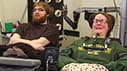
Nathan Copeland, the current participant, and Jan Scheuermann, the previous participant in the brain computer interface study, share a moment together.
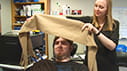
Researcher Jen Collinger prepares to cover Nathan Copeland’s eyes with a scarf before performing sensory demonstration.
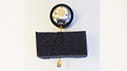
An example of the microelectrode array implanted in Nathan Copeland’s brain.
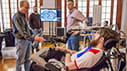
Andrew Schwartz, Ph.D., Distinguished Professor of Neurobiology and Chair in Systems Neuroscience, Pitt School of Medicine and a pioneer in the field of neural prosthetics, attempts to shake the robotic arm controlled by signals from Nathan Copeland’s brain as Dr. Robert Gaunt and other researchers observe.
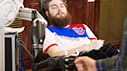
Nathan Copeland attempts a fist bump with the mind-controlled robotic arm.
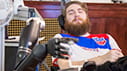
Nathan Copeland extends the mind-controlled robotic arm.
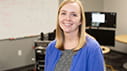
Jennifer Collinger, Ph.D. Assistant Professor, Department of Physical Medicine and Rehabilitation, University of Pittsburgh and research scientist for the VA Pittsburgh Healthcare System
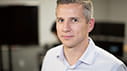
Robert Gaunt, Ph.D., Assistant Professor of Physical Medicine and Rehabilitation at the University of Pittsburgh
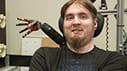
Study participant Nathan Copeland with the mind-controlled robotic arm behind him.
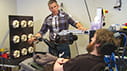
Researcher Robert Gaunt prepares Nathan Copeland for sensory testing, where Nathan feels his fingers through the mind-controlled robotic arm.
2012 - Jan Scheuermann
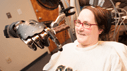
Jan Scheuermann, who has quadriplegia, brings a chocolate bar to her mouth using a robot arm she is guiding with her thoughts. Research assistant Elke Brown, M.D., watches in the background.
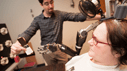
Jan Scheuermann, who has quadriplegia, reaches with a thought-controlled robot arm for a chocolate bar held by research assistant Brian Wodlinger, Ph.D.
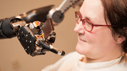
Jan Scheuermann, who has quadriplegia, gazes at the chocolate bar she intends to guide into her mouth with a thought-controlled robot arm.
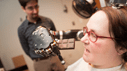
Jan Scheuermann, who has quadriplegia, prepares to take a bite out of a chocolate bar she is guiding into her mouth with a thought-controlled robot arm while research assistant Brian Wodlinger, Ph.D., watches.
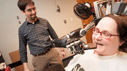
Jan Scheuermann, who has quadriplegia, takes a bite out of a chocolate bar she has guided into her mouth with a thought-controlled robot arm. Research assistants Brian Wodlinger, Ph.D., and Elke Brown, M.D., watch in the background.
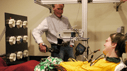
Researcher Andrew Schwartz, Ph.D., shakes Jan Scheuermann’s robot hand, which she calls Hector.
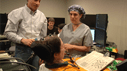
Researchers Andrew Schwartz, Ph.D., and Elizabeth Tyler-Kabara, M.D., Ph.D., talk with Jan Scheuermann. Research assistants John Downey (facing camera) and Brian Wodlinger, Ph.D., chat in the background.
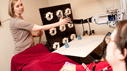
Jan Scheuermann reaches out with the thought-controlled robot arm to touch the hand of researcher Jennifer Collinger, Ph.D.
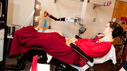
Jan Scheuermann stacks cones with a mind-controlled robot arm. Research assistant Brian Wodlinger, Ph.D., watches her work.
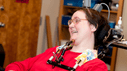
Jan Scheuermann, 53, of Whitehall Borough, has quadriplegia for more than nine years and is participating in a trial testing brain computer interface technology that allows her to move a robot arm with her thoughts.
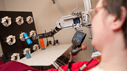
Jan Scheuermann stacks cones with a mind-controlled robot arm.
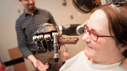
One Small Nibble, One Giant Bite; Woman Guides Robot Arm With Thoughts.
2011 - Tim Hemmes
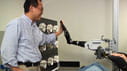
Study participant Tim Hemmes (right) reaching out to his researcher, Wei Wang, M.D., Ph.D. (left), using a brain-controlled prosthetic arm. Also pictured: Research team member Jennifer L. Collinger, Ph.D and Katie Schaffer.
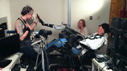
Study participant Tim Hemmes (right) reaching out to his girlfriend, Katie Schaffer (left), using a brain-controlled prosthetic arm. Also pictured: Research team member Jennifer L. Collinger, Ph.D.
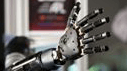
The prosthetic arm, designed by the John Hopkins University's Applied Physics Laboratory (JHU/APL) and funded by the U.S. Department of Defense's Defense Advanced Research Projects Agency (DARPA). Photo credit: DARPA and JHU/APL.

The study's co-principal investigator and UPMC Rehabilitation Institute director Michael Boninger, M.D., and Mr. Hemmes.

Mr. Hemmes' reaction to reaching out to touch hands with someone for the first time in seven years.
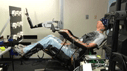
As part of testing, Mr. Hemmes willed the arm to reach for a ball placed onto specific areas of a board in front of him.
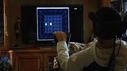
In addition to the arm testing, Mr. Hemmes used his thoughts to guide a ball from the middle of a large television screen either up, down, left or right to a target, within a time limit.
















