UPMC/University of Pittsburgh Schools of the Health Sciences
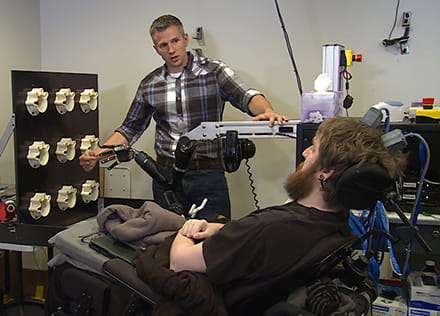
Researcher Dr. Robert Gaunt prepares Nathan Copeland for sensory testing, where Nathan feels his fingers through the mind-controlled robotic arm.
PITTSBURGH, Oct. 13, 2016 – Imagine being in an accident that leaves you unable to feel any sensation in your arms and fingers. Now imagine regaining that sensation, a decade later, through a mind-controlled robotic arm that is directly connected to your brain.
That is what 28-year-old Nathan Copeland experienced after he came out of brain surgery and was connected to the Brain Computer Interface (BCI), developed by researchers at the University of Pittsburgh and UPMC. In a study published online today in Science Translational Medicine, a team of experts led by Robert Gaunt, Ph.D., assistant professor of physical medicine and rehabilitation at Pitt, demonstrated for the first time ever in humans a technology that allows Mr. Copeland to experience the sensation of touch through a robotic arm that he controls with his brain.
“The most important result in this study is that microstimulation of sensory cortex can elicit natural sensation instead of tingling,” said study co-author Andrew B. Schwartz, Ph.D., distinguished professor of neurobiology and chair in systems neuroscience, Pitt School of Medicine, and a member of the University of Pittsburgh Brain Institute. “This stimulation is safe, and the evoked sensations are stable over months. There is still a lot of research that needs to be carried out to better understand the stimulation patterns needed to help patients make better movements.”
Read the full press release here.
Downloadable images and video are available upon request. Interested media may contact Anastasia Gorelova.
















